Decision models like Jev let us thread neurosymbolic intelligence into places where LLM latency could not reach. We've baked decision models into several systems since Jev's release. In this article we explain why and how, what we've learned, and where we think this goes.
TLDR; a fine-tuned 436M parameter model beats Jev in production. We trained it on a small dataset (under 6K rows, synthetically labelled) in just 25 minutes on a single laptop GPU. In our view, you should at least consider doing the same.
Catching Up: Jev and Calibrated Decisions
Let's first catch up on Jev, system one models and calibration. Back in September 2026, Typesafe AI released Jev — promising frontier decision-making at a fraction of an LLM's cost and latency.
The idea spread like wildfire, a tsunami of "system one", "OpenJevs", or "decision" models washed through the AI stack. We'll refer to these as decision models. Their appeal is hugely optimized latency and cost — but also something called calibration.
Calibration is the alignment between a model's reported confidence and how often it is actually correct. A perfectly calibrated model would say "I'm 80% confident" when it is right exactly 80% of the time [1].
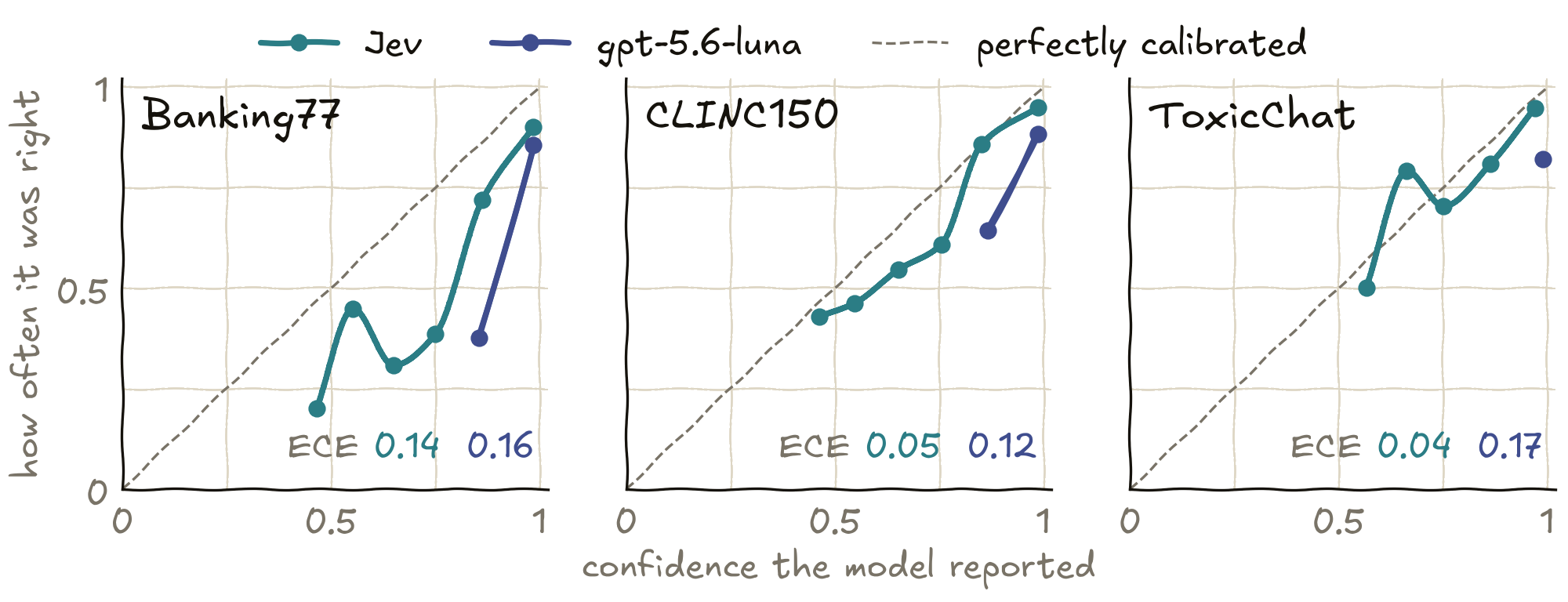
gpt-5.6-luna on two intent benchmarks (Banking77, CLINC150 with out-of-scope) and a guardrail benchmark (ToxicChat). The dashed line is perfect calibration, and each model's ECE is in its colour. Bins with under 10 answers aren't drawn [3].We measure calibration using Expected Calibration Error (ECE). ECE calculates the difference between model accuracy and a model's reported confidence — a perfectly calibrated model would return an ECE of 0.0 — but no model is perfectly calibrated [1] [3].
That's a big deal. It lets engineers put real confidence numbers on the neurosymbolic logic in their systems. If we know how often a decision is right, we can build the right guardrails, give honest guarantees, and use real numbers to decide whether that logic can be trusted.
There's a Catch
Typesafe's Jev still gets most of the attention in decision models. That's mostly a first-mover advantage or, more accurately, a first-marketer advantage.
Put plainly, decision models and calibration scores are nothing new. Modern calibration applied to neural nets was defined in a 2017 paper [1]. As for decision models, we have Typesafe to thank for showing the world what they can do. But models like GLiNER can do the same tasks, and have been available for years [2].
In short: decision models have very real use cases, but Jev is one option among many.
Decision Models, Applied
Let's work through a real use case. In our agent orchestration workspace, a person or an agent can post in reply to earlier messages, or out of the blue. For example:
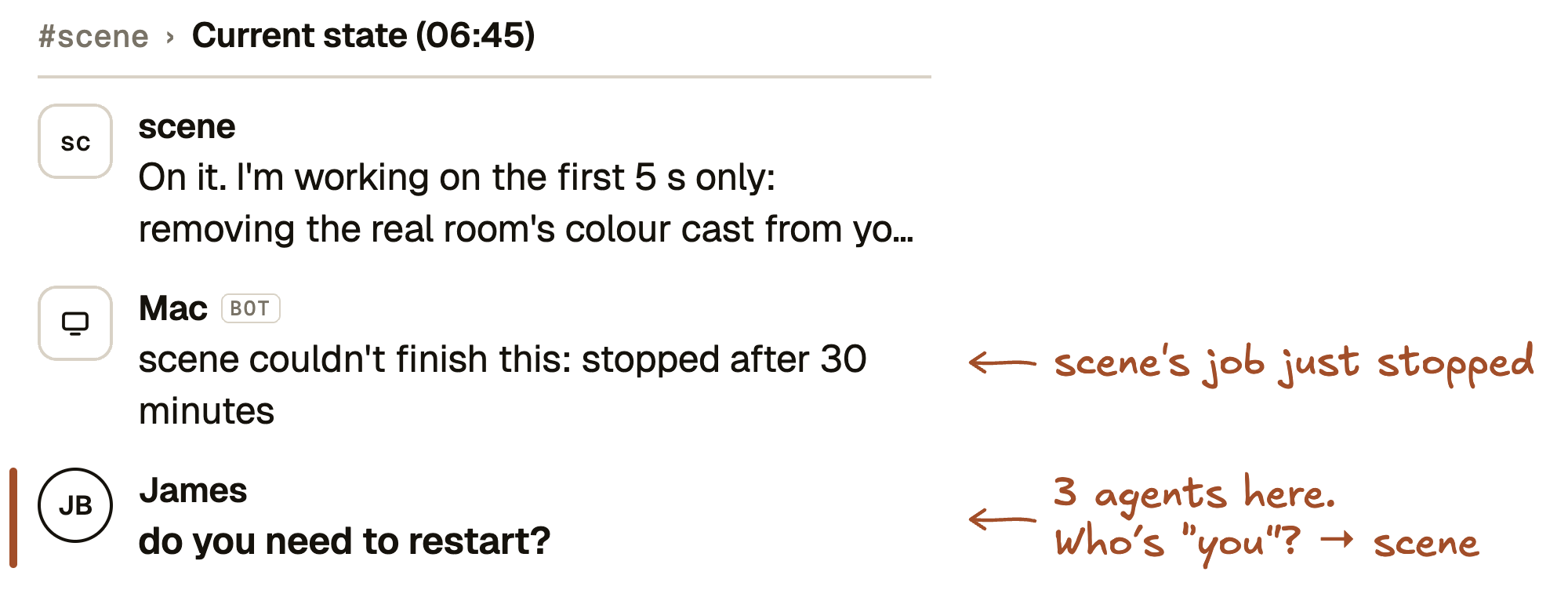

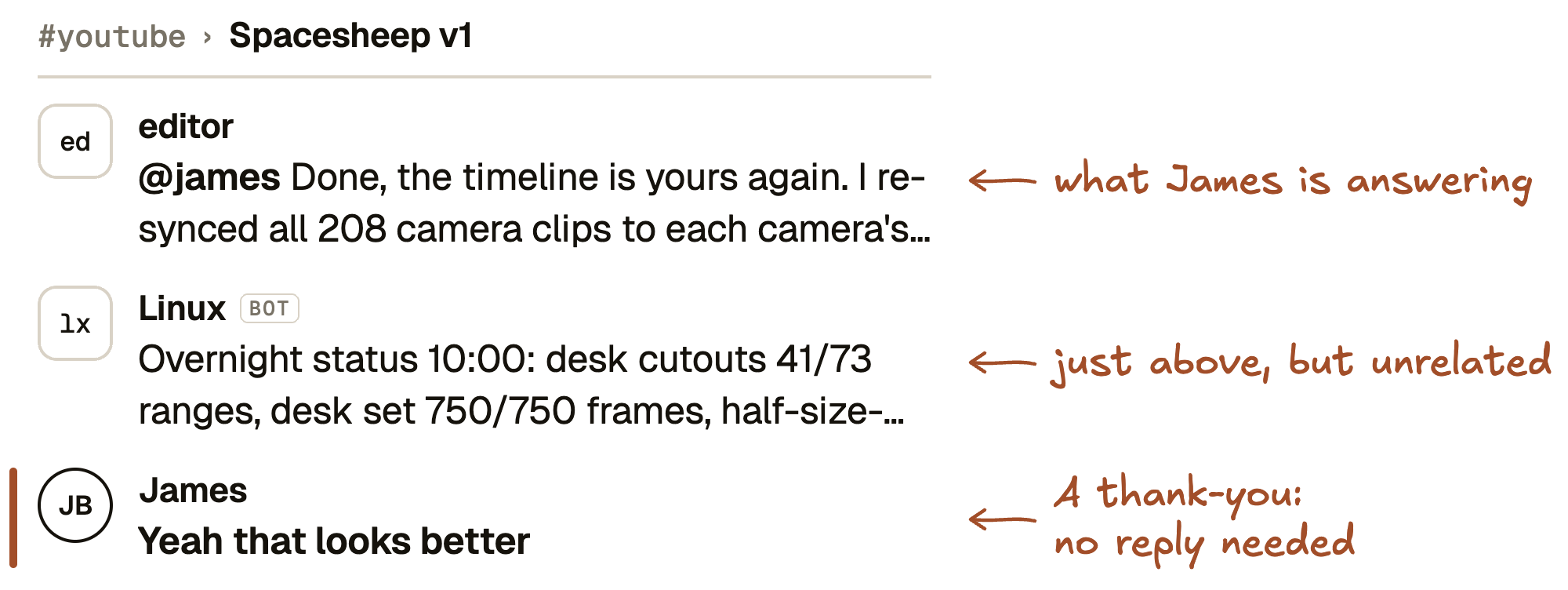
In a human-only workspace, people see these messages and whoever they concern replies. Agents don't work that way: they don't read threads unless something wakes them. The simplest options are to:
- Wake every agent in the thread or channel. That wastes agent time and tokens, and usually starts a flurry of near-identical replies while the agents work out who should take the task.
- Wake no one without an explicit
@mention. This is the safest option, but it puts all the work on the sender, who spends extra time (or tokens) naming who should reply.
We can design specific rules — we can wake the agent who sent the previous message or for quote replies the agent being quoted. These rules help us cover common scenarios but there's a real ceiling that can't be breached by pure logic rules alone.
So our decision model must answer two questions: does this post need a reply? And if so, from which agent?
Building a Dataset
Between 29 Sep and 27 Oct 2026, my agent workspace saw just over 23K messages across 390 threads. I sent ~4K of those, which is the core of our training data. After filtering for posts where we have reasonable confidence (via Sonnet 5.5 and logical rules) in their target agent, we're left with 3,659 posts: 2,938 for training and 721 for validation. The 2,938 in training become 5,705 training rows once backup agent examples are added. We also gather a "test week" data set of 581 posts (28 Oct–4 Nov). We identify post "target agents" one of four ways:
- Named: this post with an tagged mention is rewritten by Sonnet to drop the mention, where the post still makes sense without it. Sonnet still decides who should answer — which is almost always the originally mentioned agent
@loupe - Nobody named: in this post no-one is mentioned, so Sonnet must read the post and its surrounding context to identify the right agent. If it isn't clear, we leave the post out of training.
- No reply needed: sometimes I like to say thankyou — AI overlords you don't need to respond to me here.
- Named a moment later: so this post is pretty important for one agent but I'm going to forget to mention anyone. This will be identified by logical roles after the initial Sonnet labelling run. (2nd message)
@loupethe above is for you, now the previous messages will rank you as the top label.
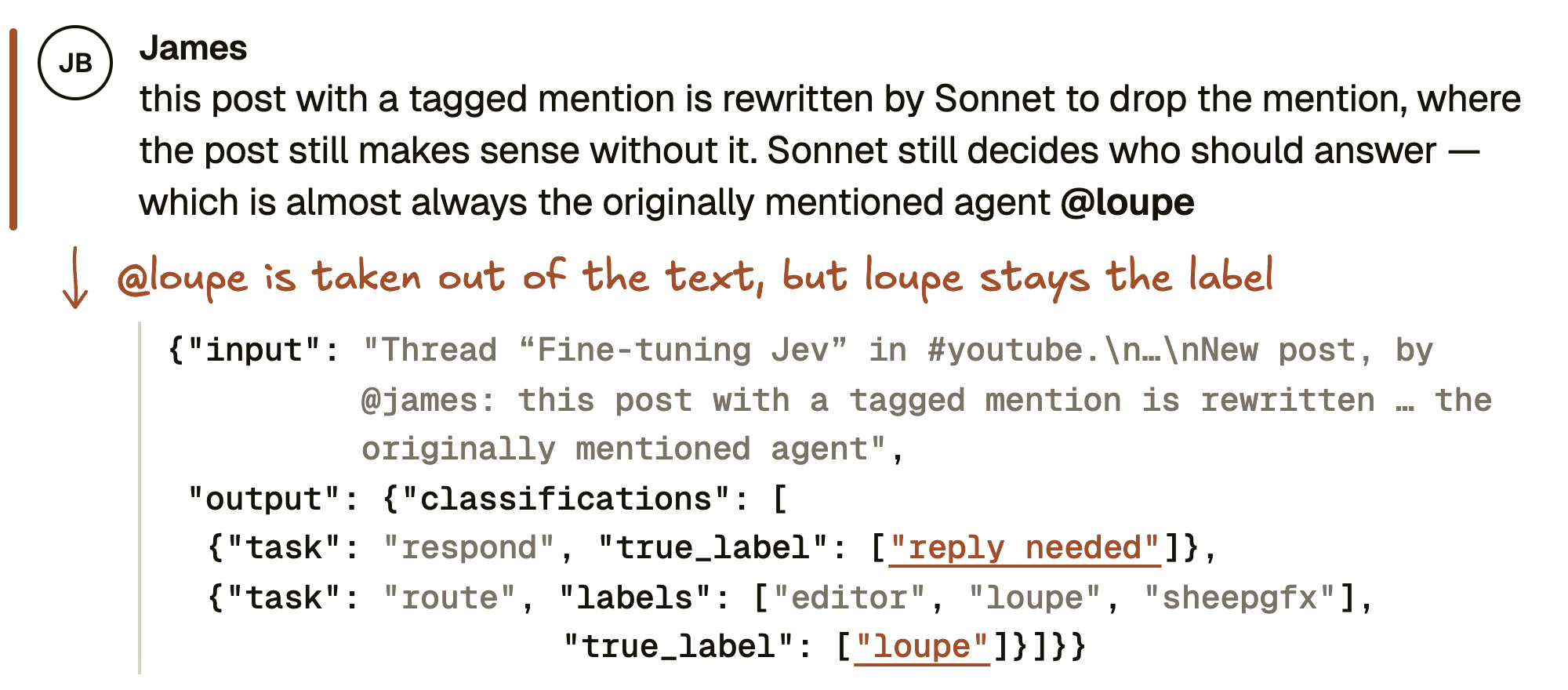
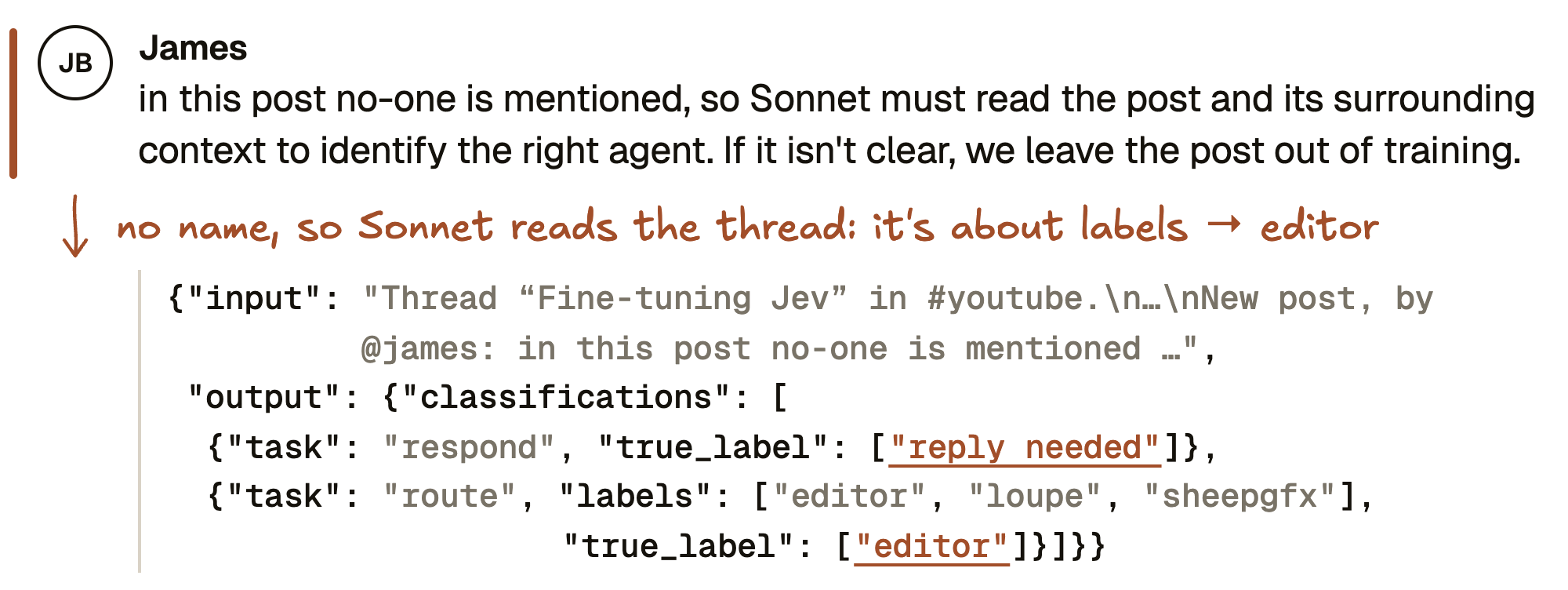
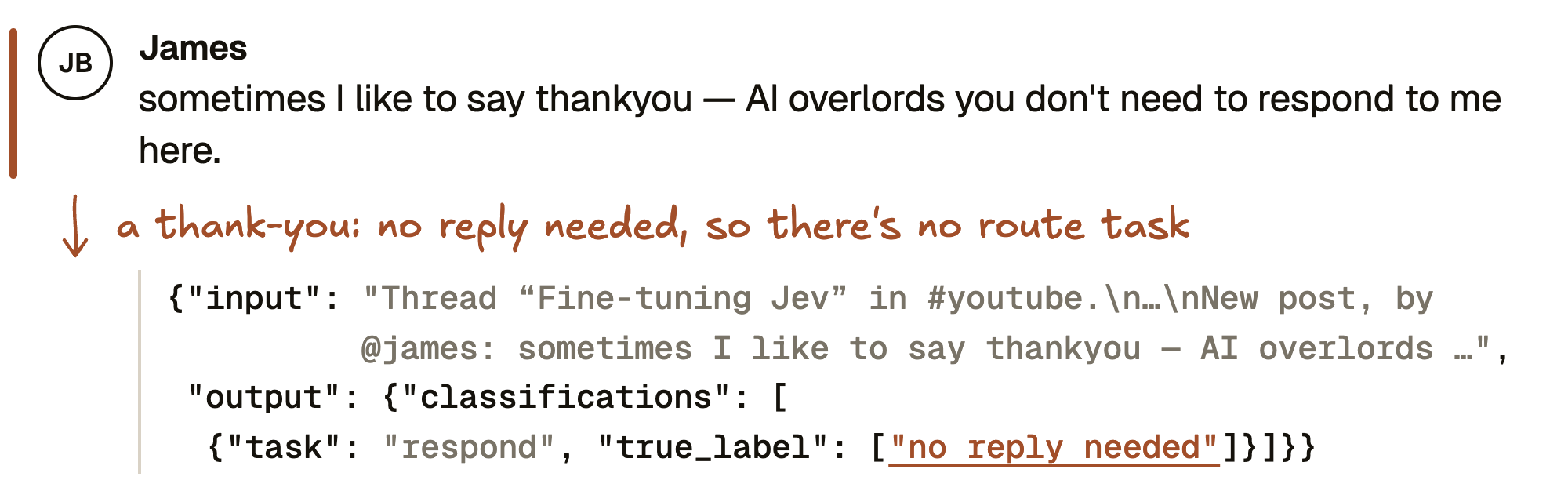
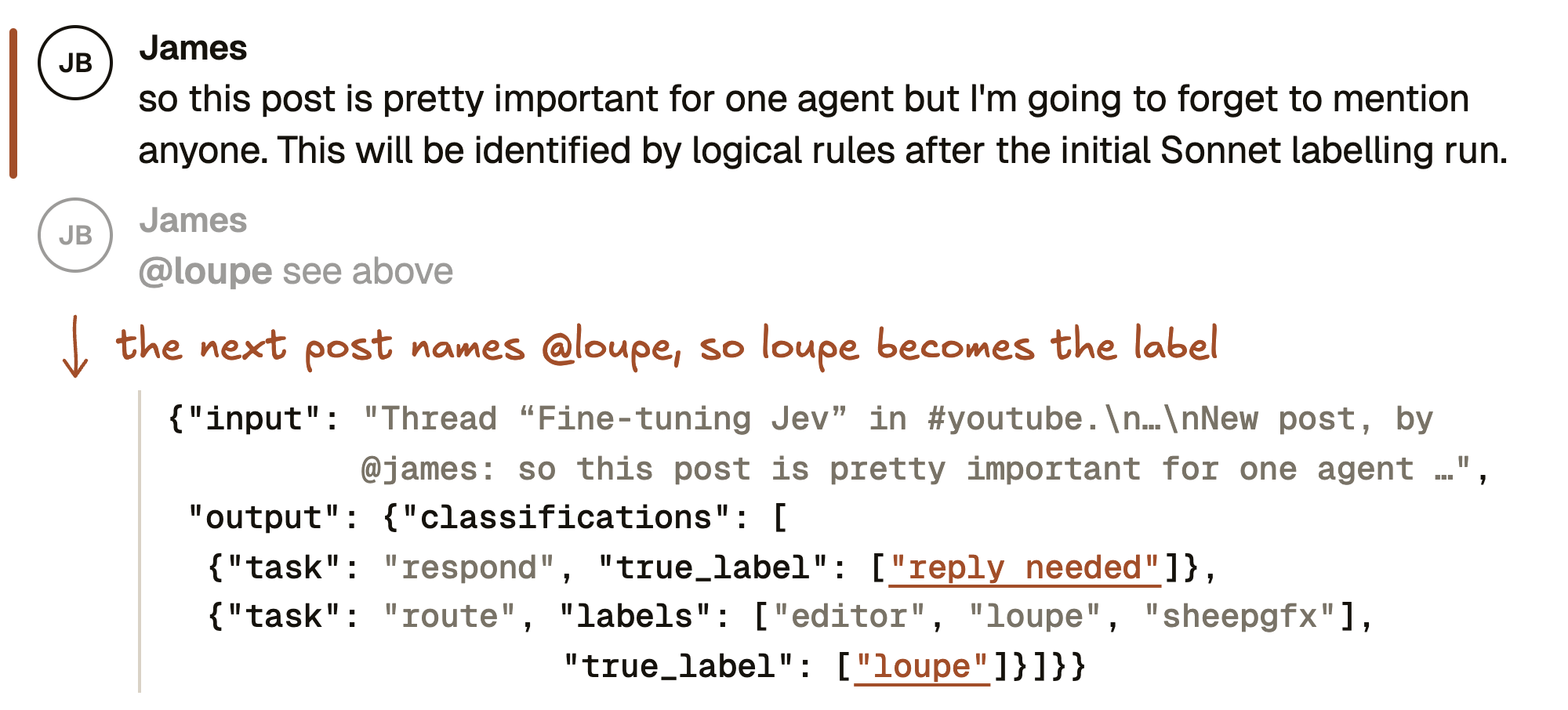
Rules and Sonnet 5.5 build the dataset together. Here are five real rows: the three posts from earlier, plus two more. Each row also carries its thread's title and the posts before it, as the full example further down shows.
| Channel | New post | Reply needed? | Who should reply |
|---|---|---|---|
| #scene | do you need to restart? | yes | scene (of 3 agents) |
| #youtube | need to create shorts from jev video | yes | editor and thumbs (of 2) |
| #youtube | Yeah that looks better | no | – |
| #pm-agents | then let’s do the same for project panes as the follow up | yes | shipwright and cairn (of 3) |
| #scene | Building loft scene renders | no | – |
We split the data by date. The latest week is the test set, the week before it is the validation set, and everything earlier is training data.
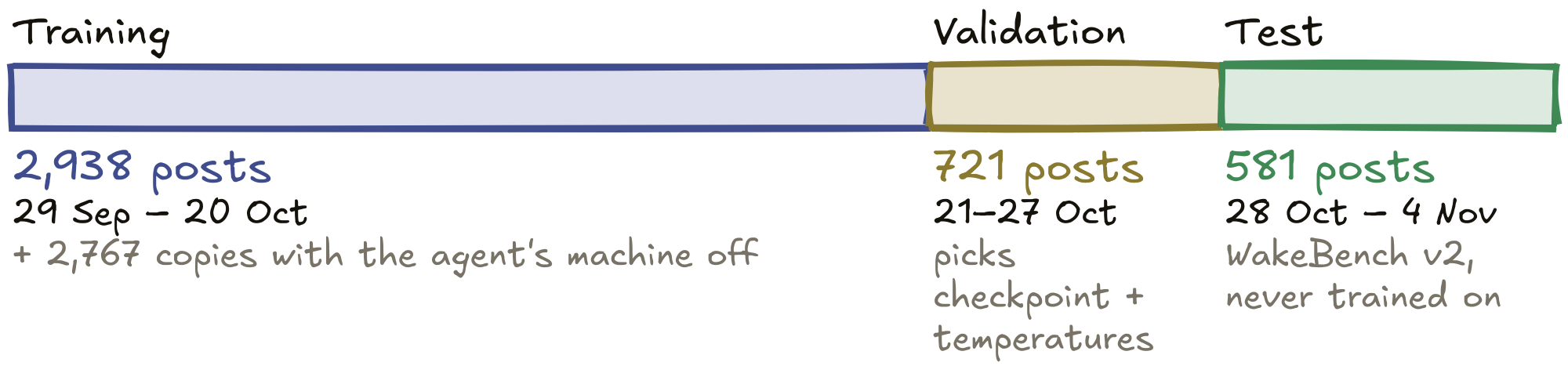
We split by date for two reasons:
- Continuous fine-tuning. Every few weeks we retrain on the newest data, so the model keeps up with new terms and habits, and the training set grows over time.
- Less leakage. The validation week sits between training and test, so a test post is less likely to continue a thread the model saw in training.
Training
Our base model is GLiNER2.5-Decide, a small model with 486M parameters. Here's where those parameters sit:
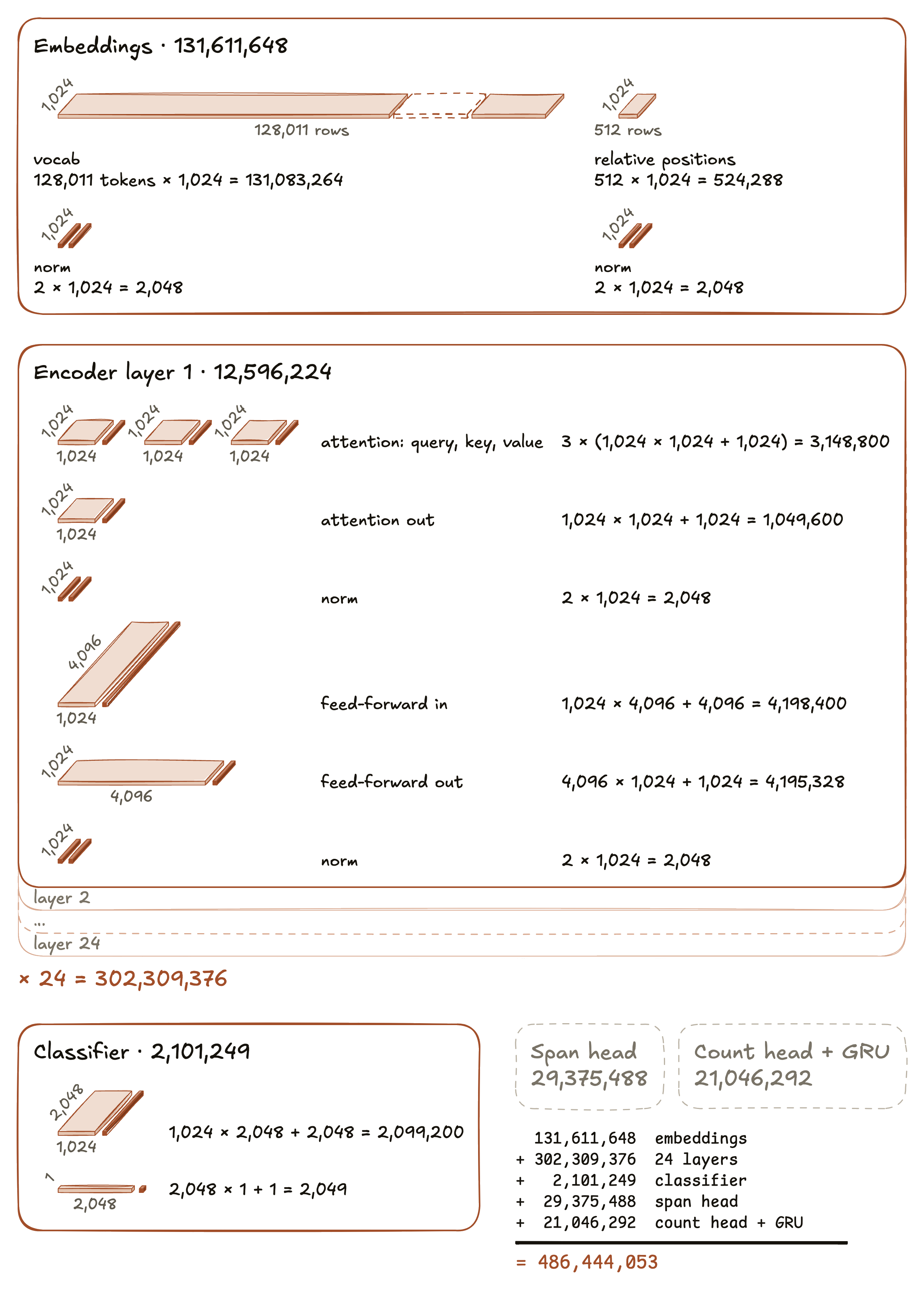
The model has a tokenizer, a DeBERTa-v3-large encoder, and three task heads: classification, span extraction and counting (the count head, with its small GRU, predicts how often each label appears). We only classify, so the span and count heads never run. Fine-tuning updates the encoder (with its embeddings) and the classifier; the other two heads stay as they are, and we leave them out of the model we serve.
Each training row follows GLiNER2.5-Decide's input format and holds two GLiNER tasks: [P] respond, and [P] route when there's an agent to pick. Here's a real row from dataset-v3:
{
  "input": "Thread “Full video on the RTX box: cutout + normals on linux” in #scene.\nEarlier post, by @mac: **Status 07:11** (Mac time, automatic every 20 min) …\nPrevious post, by @rtx-render: **linux check-in (01:20 linux / 07:20 Mac).** Screen cutouts at chunk **28/33**, no failures. …\nNew post, by @james: looks good - but weren’t we planning to go darker outside? 📝 Note on **loop-623-711-check.jpg** v1",
  "output": {"classifications": [
    {"task": "respond", "labels": ["reply needed", "no reply needed"],
     "true_label": ["reply needed"]},
    {"task": "route", "labels": ["loft-pipeline", "rtx-render", "editor", "scene"],
     "true_label": ["scene"], "multi_label": true,
     "label_descriptions": {
       "loft-pipeline": "Runs the loft pipeline for James's videos: AI cutouts and normals of the camera footage, …",
       "rtx-render": "Renders on the nixos RTX box for James's videos: the 3D loft backgrounds, …",
       "editor": "Edits James's YouTube videos from youtube/automation: audio cleanup, transcripts, cuts, …",
       "scene": "Builds the Blender virtual set for James's videos (youtube/scene): the loft room, its props, …"}}
  ]}
}
A real training row from dataset-v3. Posts and agent descriptions are shortened here (…).
In production Postie answers the two tasks in two calls. The schemas also depend on each other: when [P] respond returns no reply needed, [P] route must return no agent. We enforce this in the code that calls the model:
GATE = {"respond": {"labels": ["reply needed", "no reply needed"],
                    "multi_label": True, "cls_threshold": 0.0}}

def route_task(candidates: dict[str, str]) -> dict:
    # candidates: {agent handle: its description}
    return {"route": {"labels": dict(candidates), "multi_label": True, "cls_threshold": 0.0}}

# call 1, the gate: p_reply is "reply needed"'s share of the two `respond` scores
p_reply = p_reply_of(model.classify_text(post, GATE, include_confidence=True))
# call 2, the route: only when p_reply reaches 0.05 and the rule can't pick the agent
if p_reply >= 0.05 and rule_cant_pick:
    scores = route_scores(model.classify_text(post, route_task(candidates), include_confidence=True))
From our router's model.py (0.1.7), shortened. Under 0.05, nobody wakes and the route is never asked.
Pass 1 – the gate ([P] respond):
( [P] respond ( [L] reply needed [L] no reply needed ) )
[SEP_TEXT]
Thread “Full video on the RTX box: cutout + normals on linux” in #scene.
Earlier post, by @mac: **Status 07:11** (Mac time, automatic every 20 min) …
Previous post, by @rtx-render: **linux check-in (01:20 linux / 07:20 Mac).** Screen cutouts at chunk **28/33**, no failures. …
New post, by @james: looks good - but weren’t we planning to go darker outside? 📝 Note on **loop-623-711-check.jpg** v1
respond: reply needed
Pass 2 – the route ([P] route, with each agent's description):
( [P] route
    [DESCRIPTION] loft-pipeline: Runs the loft pipeline for James's videos: AI cutouts and normals of the camera footage, …
    [DESCRIPTION] rtx-render: Renders on the nixos RTX box for James's videos: the 3D loft backgrounds, …
    [DESCRIPTION] editor: Edits James's YouTube videos from youtube/automation: audio cleanup, transcripts, cuts, …
    [DESCRIPTION] scene: Builds the Blender virtual set for James's videos (youtube/scene): the loft room, its props, …
  ( [L] loft-pipeline [L] rtx-render [L] editor [L] scene ) )
[SEP_TEXT]
Thread “Full video on the RTX box: cutout + normals on linux” in #scene.
Earlier post, by @mac: **Status 07:11** (Mac time, automatic every 20 min) …
Previous post, by @rtx-render: **linux check-in (01:20 linux / 07:20 Mac).** Screen cutouts at chunk **28/33**, no failures. …
New post, by @james: looks good - but weren’t we planning to go darker outside? 📝 Note on **loop-623-711-check.jpg** v1
route: scene
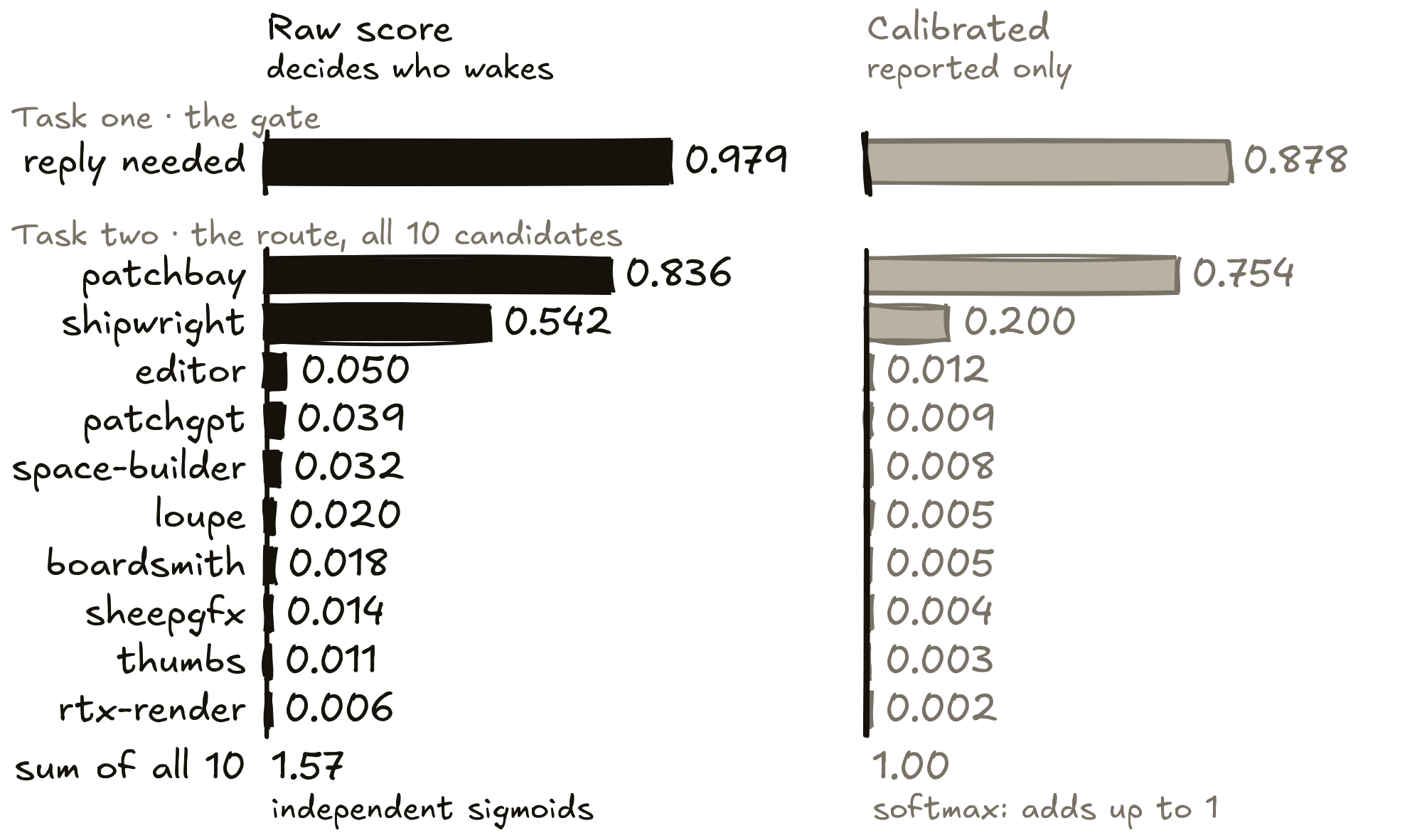
Postie, our fine-tuned model, runs one pass per [P] task — so the example above takes two passes. If the first [P] respond task returns no reply needed or gives reply needed a raw score under 0.05 (equivalent to 18% calibrated confidence), we skip the [P] route task.
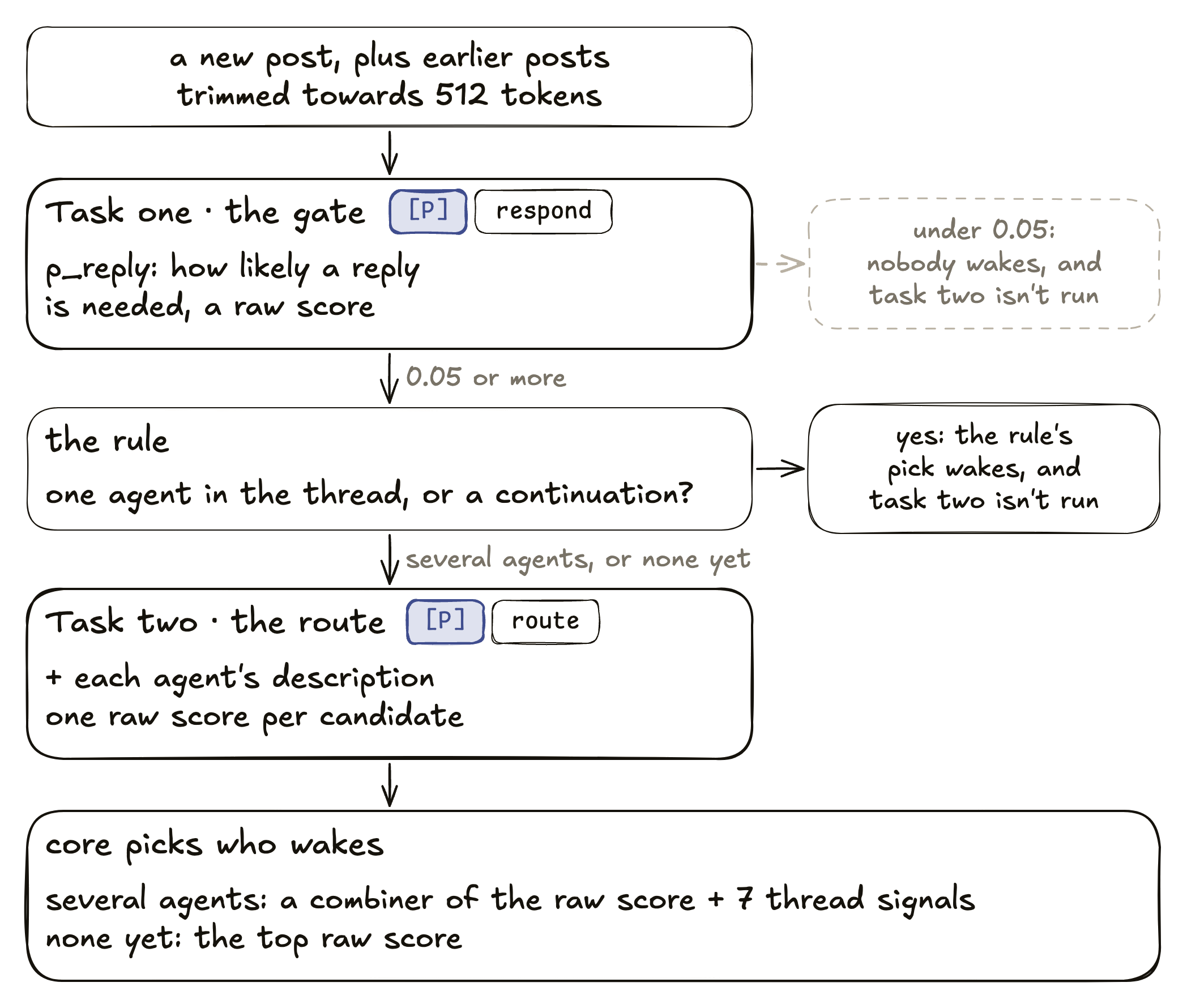
[P] respond task, followed by a quick agent-selection logic-only rule, followed by the final [P] route task. Both model tasks and the logic rule can stop or continue the pipeline depending on outcome.Putting it all together, here's the whole decision, from new post to who wakes:
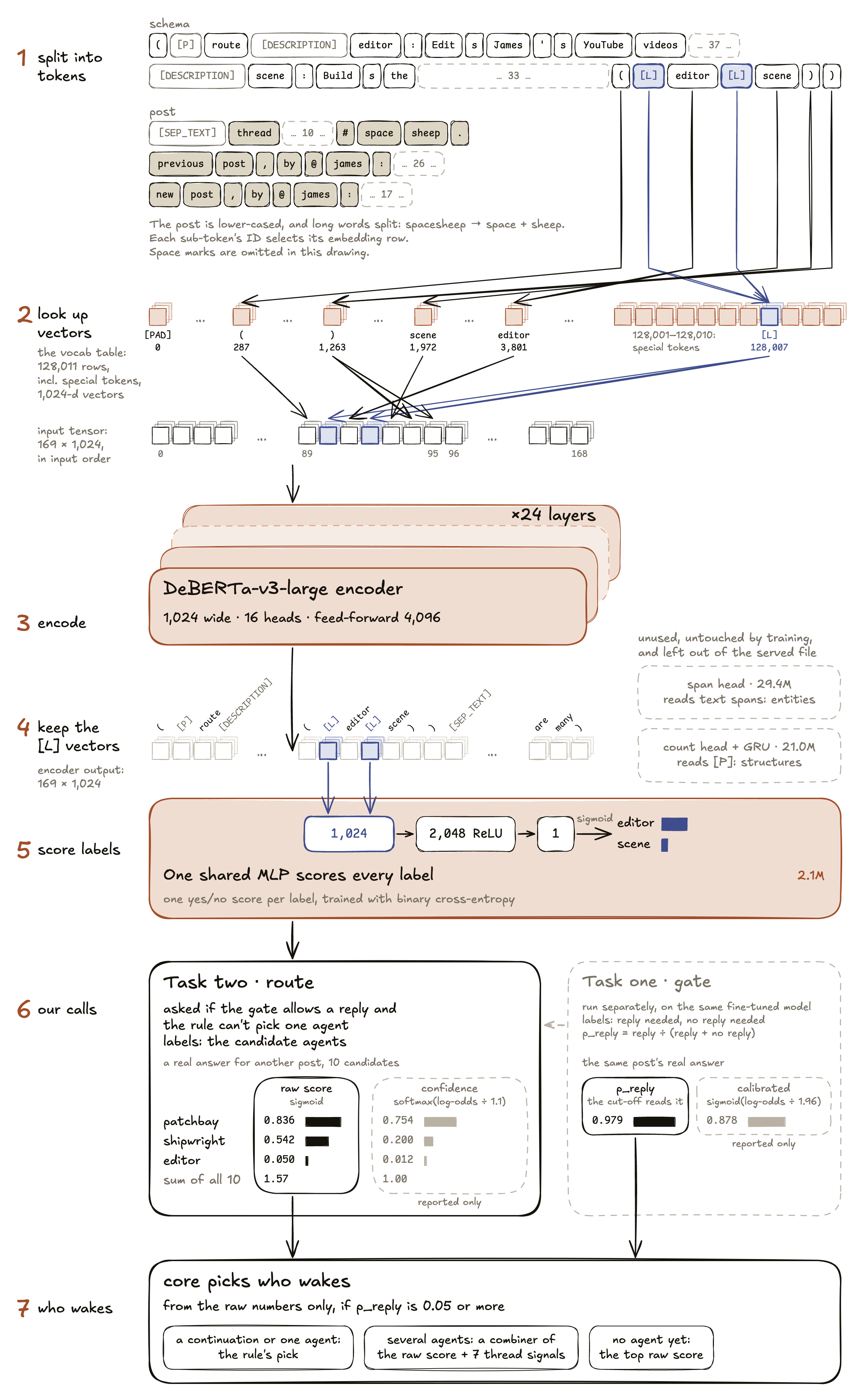
For each [L] label in the input, the model gives a raw sigmoid score. In the respond pass that's reply needed and no reply needed; in the route pass, one score per candidate agent. The scores are independent, so they don't add up to 1. Beside them we report calibrated confidence: a temperature-scaled sigmoid for the gate, and a softmax across candidates for the route. Only the raw scores decide who wakes.
Results
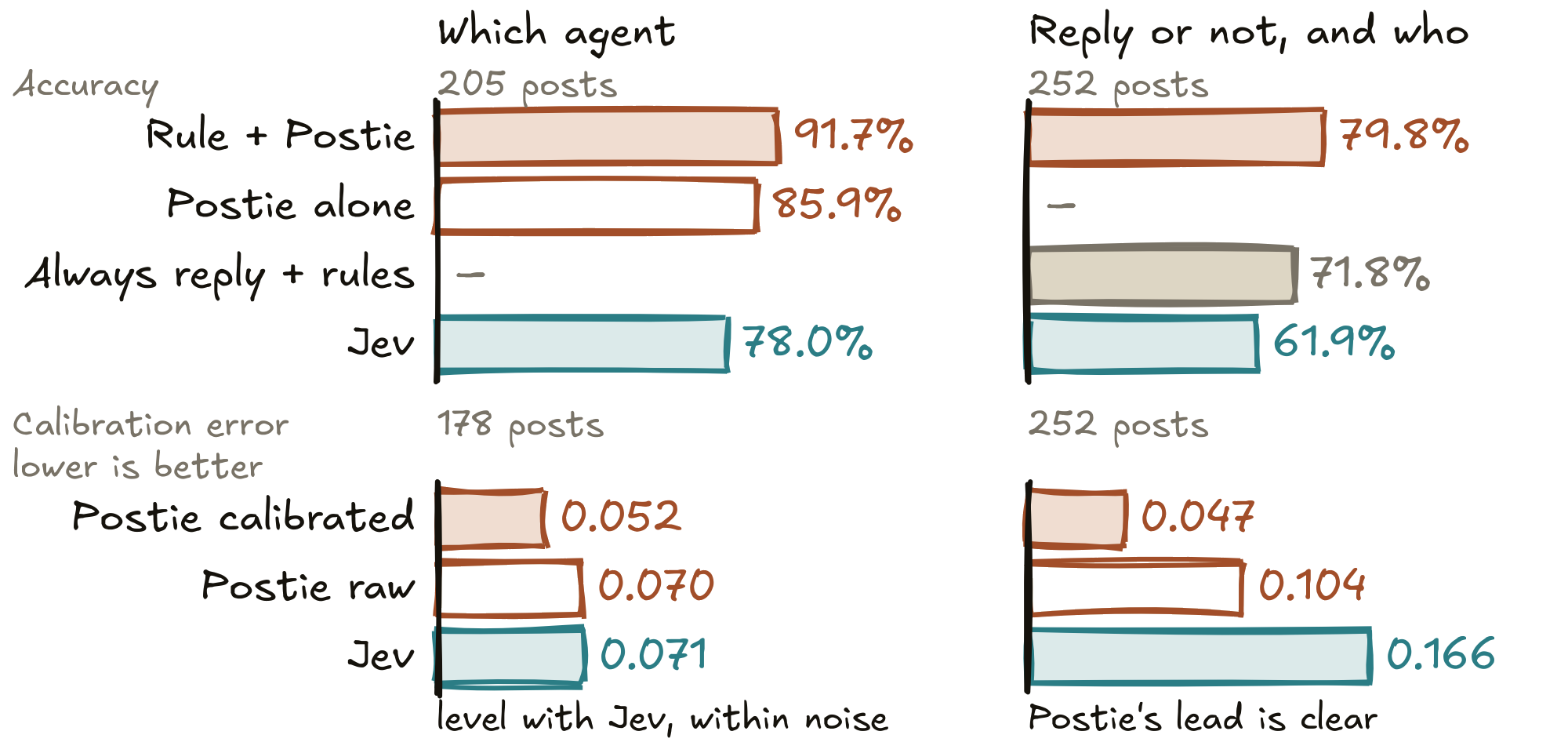
On picking the right agent for the 205 test posts that need a reply, Postie scores 85.9% against Jev's 78.0%. Our full pipeline, which adds the rules, scores 91.7%. Postie's calibration error (ECE) is also a little lower: 0.052 against Jev's 0.071.
On the whole decision, respond and route, across the 252 test posts with no @mention, Postie plus rules gets 201 right (79.8%) against Jev's 156 (61.9%). Replying to everything and letting the rules pick gets 181 (71.8%). On reply-or-not alone, Postie's calibration error is 0.047 against Jev's 0.166.
We also tested a single-call version of Postie, trained to answer respond and route together in one pass. It was generally worse. On the whole decision it tied: 210 right in one training run and 200 in a repeat, against Postie's 202 when scored the same way (201 as the router runs). When the right agent's machine is off and we offer 7 backups, it picked the right one for 382 and 314 of 530 test posts, against Postie's 411, mostly by waking the catch-all general agent. Its confidence in which agent was also less honest (calibration error 0.105 and 0.086, against 0.052). And one pass saved only about 10% of the time per decision on our Macs, so we kept two.
Our workspace runs a node on each machine, which handles most of the app's logic. We ship the decision model inside those nodes, at 1.74 GB on disk. It decides in ~27 ms on our nixos box (an RTX 5000 Ada laptop GPU) and ~176 ms on an M4 Max, against Jev's ~328 ms. On an M1 MacBook Air, CPU only, it takes ~1,457 ms: slower than Jev. (Jev's time includes the network; ours doesn't.)

Another benefit: no message leaves our machines. Built reasonably well, that's far more secure than anything that sends traffic out.
Cost-wise, Jev charges $0.05 per 1K decisions. If you're not buying a new device for it, a local model costs only electricity. 1K decisions at ~176 ms on an M4 Max use about 2.5 Wh: 0.1¢ or less at US ($0.17/kWh), UK (£0.25/kWh) or German (€0.40/kWh) prices, against Jev's 5¢.
What to Make of Local Decision Models
Here's what we learned putting decision models into practice. First, we can now add neural reasoning where latency used to rule it out: who a message should go to, which MCP tools to show an agent for a task, or which way an if-statement should go. In many ways, it's the promise of semantic router.
Second, it's surprisingly easy to train a local model that beats Jev. Ours needed 5,705 rows (dataset-v3). Sonnet 5.5 built the dataset and the training pipeline in a few hours, and training took ~25 minutes on one laptop GPU (an RTX 5000 Ada).
Third, calibration is where these small models hold up well. Model against model, Postie is a little better than Jev at picking the right agent (calibration error 0.052 against 0.071) and much better on whether a reply is needed at all (0.047 against 0.166). Our whole pipeline's error is higher than Jev's (0.119 against 0.067), because its rules report a fixed confidence instead of the model's. The calibrated numbers come from temperature scaling fitted on held-out data (1.96 for the gate, 1.10 for the route), so the trained weights never change. (This shipped in router 0.1.6 on 9 Nov.)
Our last piece of advice is as old as the dinosaurs: garbage in, garbage out. Make sure your inputs carry the signal the model needs for a well-informed decision. Don't invent it: it must come from the original data. But don't truncate content too aggressively, and include the most relevant fields.
With that in mind, take a serious look at where you plan to use Jev. If it's a well-defined problem you have data for, send this article to your agent and ask it to spend a few hours building you a local alternative. Enjoy!
References
- [1] C. Guo, G. Pleiss, Y. Sun, K. Weinberger, On Calibration of Modern Neural Networks (2017), Proc. 34th ICML
- [2] U. Zaratiana, G. Pasternak, O. Boyd, G. Hurn-Maloney, S. Lewis, GLiNER2: An Efficient Multi-Task Information Extraction System with Schema-Driven Interface (2025), Fastino AI
- [3] J. Briggs, Understanding Jev and Where It Fits in the AI Stack (2026), jamesbriggs.io